Alla titlar av »Elektra Diakolambrianou«
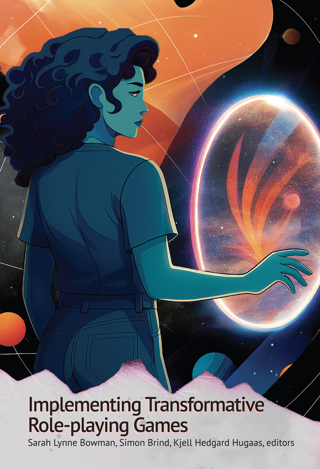
Del 2 i serie
Implementing Transformative Role-playing Games
Mjukband
This textbook explores implementation practices for running transformative analog role-playing games, such as transformative leisure, educational, and therapeutic applications. We foreground central considerations for hacking existing games, framing, scaling up existing designs, adapting to the needs of specific populations, creating functional groups, and working with stakeholders.Additionally, the textbook covers many practical considerations when producing and running logistics. Examples include project management, organizational teams, establishing the setting, character writing, location logistics, as well as tech, interaction, and sensory design. We offer suggestions for communication, casting, documentation, guiding player preparation, workshop design, and onsite logistics. Next, the textbook discusses different facilitation roles and responsibilities. We describe several skills associated with good facilitation and recommendations for working in different settings. Additionally, the textbook presents general principles for cultivating safer and more accessible transformational communities surrounding play. We discuss ways to address physical and psychological risks in implementation for both organizers and players, such as injury, psychological overwhelm, and inappropriate behavior in the community. The textbook also features theories connected to the play experience, including motivation, creative agendas, and labor. Then, we present several concepts related to transforming one’s self concept, social identity, relationships with others, and spiritual development through transformative play. We include various practical recommendations for working with preparatory activities, steering, bleed, different types of immersion, interpersonal dynamics, group dynamics, and gathering play experiences through feedback and documentation. The textbook closes with a chapter offering practical advice for playtesting, iteration, and conducting research on transformative play, including study design, ethics, data gathering, and analysis. We conclude with a list of studies offering empirical evidence for the affective, cognitive, and behavioral benefits of these games. We recommend also reading the first book in this series, Transformative Role-playing Game Design, edited by Bowman, Diakolambrianou, and Brind.
295 kr
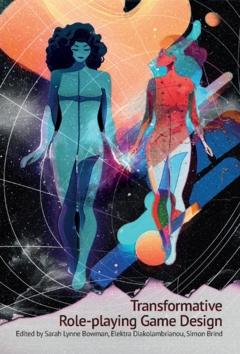
Del 1 i serie
Transformative Role-playing Game Design
Mjukband
This textbook describes theory and practice in analog role-playing game (RPG) design that encourage specific transformative impacts in participants, including tabletop, live action role-playing (larp), and Nordic and American freeform. We describe three types of transformative RPGs: transformative leisure, therapeutic, and educational. We present our model of nano-game design, offering recommendations for designing transformative goals; framing activities such as workshops and debriefs; narrative and culture design.
This interdisciplinary book highlights theories from role-playing game studies, peace and conflict studies, psychology, social psychology, sociology, counseling, anthropology, pedagogy, and several other fields. Key concepts include bleed, alibi, RPGs as transformational containers, immersion, identity, transfer, ritual, psychotherapeutic techniques, group theories, and educational theories. We emphasize psychological safety before, during, and after games, as well as strategies for cultivating transformational communities. Key topics include working with specific populations; crisis management; sensitive content and representation.
Then, we discuss working with myth, symbolism, and ritual, narrative, and postmodern magic as methods for transforming the stories of our lives. We cover forms of culture within and around RPGs, as well working with conflict in scenarios related to politics, culture, gender, sexuality, race, and ethnicity. We share thoughts around the use of RPGs to foster activism, advocacy, inclusion, and accessibility.
Finally, we offer considerations for researchers studying transformative role-playing games, including academic argument, structure, theory, method, data collection, ethics, and other considerations. We introduce key methods, including Research through Design, ethnography, and qualitative and quantitative data analysis. The book closes with a summary of evidence-based research available on the cognitive, affective, and behavioral effects of role-playing games.
Sarah Lynne Bowman, Elektra Diakolambrianou, and Simon Brind, editors
Table of Contents:
"Preface" by Sarah Lynne Bowman, Elektra Diakolambrianou, and Simon Brind
"Chapter 1: A Brief Introduction to Role-playing Games and Cousin Activities" by Sarah Lynne Bowman, Elektra Diakolambrianou, Angie Bandhoesingh, Guus van Tilborg, Alessandro Giovannucci, and Taisto Suominen
"Chapter 2: Transformative Role-playing Games: Types, Purposes, and Features" by Sarah Lynne Bowman, Elektra Diakolambrianou, Kjell Hedgard Hugaas, and Josefin Westborg
"Chapter 3: Theory, Key Concepts, and Inspirational Materials" by Elektra Diakolambrianou, Sarah Lynne Bowman, Simon Brind, Josefin Westborg, and Kjell Hedgard Hugaas
"Chapter 4: Practice: Designing for Transformative Goals" by Sarah Lynne Bowman, Simon Brind, Alessandro Giovannucci, Kjell Hedgard Hugaas, and Josefin Westborg
"Chapter 5: Safety and Community Container Setting" by Sarah Lynne Bowman, Elektra Diakolambrianou, Josephine Baird, Angie Bandhoesingh, Josefin Westborg, and Kjell Hedgard Hugaas
"Chapter 6: Myth, Symbolism, Ritual, Magic, Narrative, Culture, and Conflict" by Sarah Lynne Bowman, Simon Brind, Elektra Diakolambrianou, Kjell Hedgard Hugaas, Guus Quinten van Tilborg, Josephine Baird, and Alessandro Giovannucci
"Chapter 7: Research in Transformative Game Design" by Sarah Lynne Bowman, Josephine Baird, Kjell Hedgard Hugaas, Elektra Diakolambrianou, and Taisto Suominen
250 kr