Alla titlar av »Fedir Androshchuk«
36 %
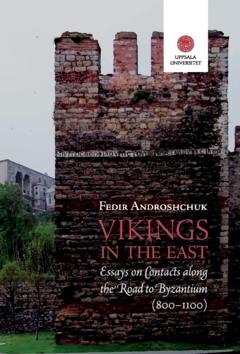
Vikings in the East : Essays on Contacts along the Road to Byzantium (800-1100)
Mjukband
It has been a tradition to write about ‘Vikings’ and ‘Varangians’ within the framework of national histories of Scandinavia. However, it is known that most of them were outsiders in the local societies of the respective countries. Vikings shaped their identity profiles beyond the social and political borders of their homelands, which means that ‘Viking Studies’ actually represent a transnational history. In order to overcome the tendency to marginalize these social categories, we need to see their place in a global historical
context. The material culture of Scandinavia reveals some ‘oriental’ influences, which took place in the 9th and 10th centuries. These influences can be traced in weaponry, riding gear, coins, clothing, jewellery, ceramic, textile and copper vessels; however, no interpretative model has yet been proposed to explain them. No critical interpretation of these objects can be undertaken without
tracing channels of communication, forms of contacts and social and cultural environments in which they were circulated. During the past decade, I have studied military aspects and cultural contacts in the early towns of Scandinavia and Rus´, and lately also contacts between Byzantium and the Viking world. One result of these studies is the identification of Byzantine influences on cloth
style, city life, court ceremonies, town planning and defense, all contributing to a ‘Byzantine dimension’ of Scandinavian history.
There are numerous examples of national histories of the North, while the concept of a transnational history still needs to be explored. The method of writing a transnational history remains to be defined, though we are aware that in dealing with a number of local histories we are required to find one story – a way of uniting different histories in a common plot. Topics that unite histories
are, for example, movements of people and the spreading of ideas and technologies across national boundaries. Such common topics are quite popular in the writing of medieval history, but depending on political and/or cultural preferences they may be approached with different attitudes; sometimes they are simply denied. The debate about a Byzantine heritage in Scandinavia offers us a case in point. The question of whether or not Byzantine cultural influences may be discerned have been debated at length and are still far from being resolved. Some historians of religion and art deny any considerable impact due to a lack of plain evidence. By contrast, other scholars, especially archaeologists, try to show the importance of Byzantium in the spreading of Christianity and in the shaping of a local elite in Scandinavia. In this debate the role of Old Rus´ as an agent of cultural transfer between Byzantium and Northern Europe has indeed been noted. Northmen, who were known in the East as Rhos and Varangians, held a unique position in world history; originating from the North they became representatives of a transnational history.
295 kr
190 kr

21 %
Del 1 i serie
Byzantium and the Viking World
Fedir Androshchuk, Monica White, Jonathan Shepard, Lesley Abrams, Roland Scheel, Marek Jankowiak, Florent Audy, Magnus Källström, Thorgunn Snædal, Valeri Yotov, Gülgün Köroğlu, Mathias Bäck, Inga Hägg, Valentina S. Shandrovskaia, Elena Mel´nikova, Anna Litvina, Fjodor Uspenskij, Sverrir Jakobsson, Scott Ashley, John H. Lind
Mjukband
The title of this book encompasses two quite different academic worlds-those of Byzantine and Scandinavian studies. Each has its own academic tradition rooted in distinctive source materials. The world of Byzantine studies, which owes its origins largely to the study of the classics, has been accused-rightly or wrongly-of being elitist; while that of Scandinavian studies has long been overshadowed by the romance of the Old Norse sagas.
Within these two academic worlds there are a number of smaller professional spaces that seldom overlap, and those of historians and archaeologists offer a prime example. Each approaches the other"s source materials hesitantly. Not all historians are at ease with the relevant archaeological sources, and the same is true for the way in which some archaeologists deal with the written sources. However, there are subjects where close collaboration between these disciplines is difficult to avoid. One such is the Scandinavians" activities in eastern Europe and Byzantium during the Viking Age and beyond. One might assume that Scandinavians-variously referred to as Rhos, Rs or Varangians-played only a marginal role in the history of the Byzantine empire. However, as is well known, the empire had need of foreigners as much as the Scandinavians had need of Byzantium in the construction of a social identity for themselves.
It would probably be no exaggeration to say that Byzantium is also needed by modern Scandinavianists as well as by Slavists. Slavonic and, in particular, Scandinavian written sources only materialised at a very late date and, for research into the history of the Viking Age, our information comes solely from the Muslim and Byzantine texts and from archaeology.
(From the preface by the editors.)
380 kr
300 kr