Serie: Studia Byzantina Upsaliensia
Visar alla böcker i serien Studia Byzantina Upsaliensia
24 %
Del 3 i serie
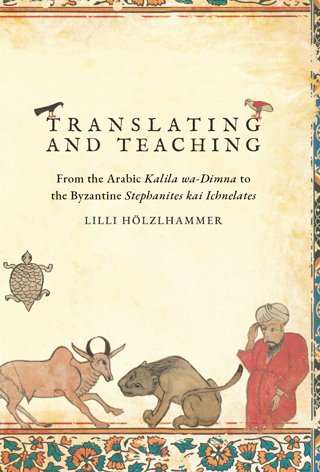
Translating and Teaching : From the Arabic Kalila wa-Dimna to the Byzantine Stephanites kai Ichnelates
Mjukband
In the late eleventh century, Symeon Seth – a Byzantine scholar originally from Antioch – produced a translation of the highly popular Arabic fable collection Kalila wa-Dimnah and dedicated it to the Byzantine emperor Alexios I Komnenos. As an educational and at the same time entertaining text, the translation under the title Stephanites kai Ichnelates quickly spread in the Byzantine Empire. Exactly how Symeon Seth changed the source text in his translation and how these changes affected the didacted content is, however, hard to tell, since there are no surviving Arabic manuscripts from before the thirteenth century.The present book sets out to address these issues. It reconstructs as closely as possible the connection between the Arabic sources and the Greek translation and rethinks medieval translation practices. It also analyzes the didactic techniques by which the text sought to teach its readers. In addition, a close examination of manuscripts and of Symeon Seth’s translation practices offer new methodological approaches. First, the comparison of manuscripts and other writings attributed to the same historical person can help constructing what in this study is termed a writing persona. Second, the analysis of didactic narratological devices employed in the text furthers the understanding of how texts attempt to educate their readers.
250 kr
190 kr

21 %
Del 2 i serie
A Catalogue of Christian Arabic Bible Translations at the British Library
Mjukband
The present work contains records of the Christian Arabic Bible translations and Bible commentaries that are kept at the Department of Asian and African Studies at the British Library. Many of these manuscripts have previously been described in various catalogues, yet with different levels of detail. The main problem, however, for those interested in the material is to navigate through all these printed Arabic, Syriac, and Coptic catalogues, as well as the handwritten acquisition registers, in order to get an overview of the corpus. As a means of enabling access to such an overview, this catalogue aims at systematizing and updating codicological and content-related information about these valuable sources, many of which have previously been described only by title and approximate date and some, which have not yet been catalogued. Based on recent research findings, it also provides information regarding the biblical versions transmitted in these translations as well as sample images of the manuscripts it describes and indices over scribes, commissioners, dating systems, immediate sources of acquisition, etc.
380 kr
300 kr

21 %
Del 1 i serie
Byzantium and the Viking World
Fedir Androshchuk, Monica White, Jonathan Shepard, Lesley Abrams, Roland Scheel, Marek Jankowiak, Florent Audy, Magnus Källström, Thorgunn Snædal, Valeri Yotov, Gülgün Köroğlu, Mathias Bäck, Inga Hägg, Valentina S. Shandrovskaia, Elena Mel´nikova, Anna Litvina, Fjodor Uspenskij, Sverrir Jakobsson, Scott Ashley, John H. Lind
Mjukband
The title of this book encompasses two quite different academic worlds-those of Byzantine and Scandinavian studies. Each has its own academic tradition rooted in distinctive source materials. The world of Byzantine studies, which owes its origins largely to the study of the classics, has been accused-rightly or wrongly-of being elitist; while that of Scandinavian studies has long been overshadowed by the romance of the Old Norse sagas.
Within these two academic worlds there are a number of smaller professional spaces that seldom overlap, and those of historians and archaeologists offer a prime example. Each approaches the other"s source materials hesitantly. Not all historians are at ease with the relevant archaeological sources, and the same is true for the way in which some archaeologists deal with the written sources. However, there are subjects where close collaboration between these disciplines is difficult to avoid. One such is the Scandinavians" activities in eastern Europe and Byzantium during the Viking Age and beyond. One might assume that Scandinavians-variously referred to as Rhos, Rs or Varangians-played only a marginal role in the history of the Byzantine empire. However, as is well known, the empire had need of foreigners as much as the Scandinavians had need of Byzantium in the construction of a social identity for themselves.
It would probably be no exaggeration to say that Byzantium is also needed by modern Scandinavianists as well as by Slavists. Slavonic and, in particular, Scandinavian written sources only materialised at a very late date and, for research into the history of the Viking Age, our information comes solely from the Muslim and Byzantine texts and from archaeology.
(From the preface by the editors.)
380 kr
300 kr